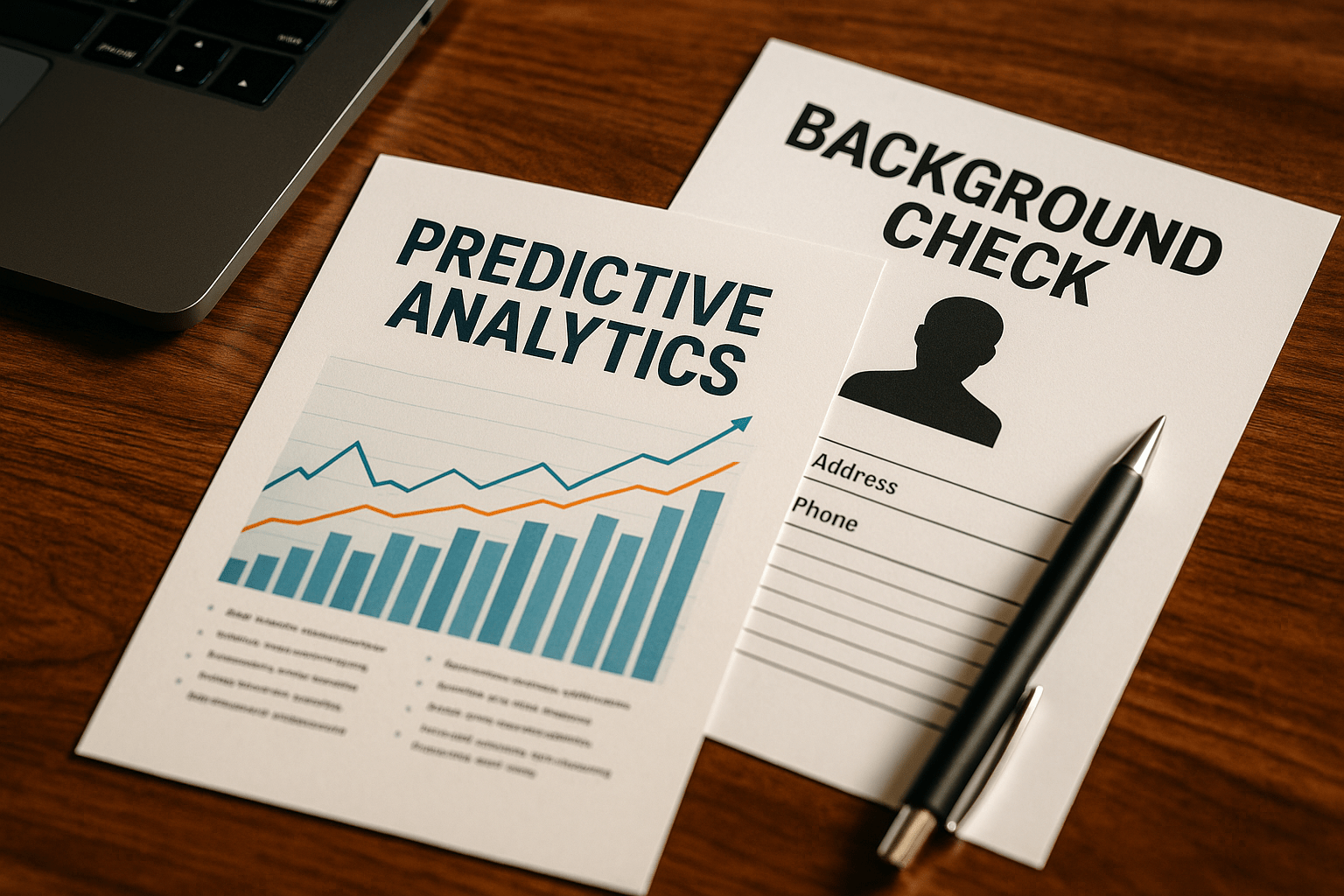
Every once in a while, I stumble on something that makes me stop and wonder how fast we’re moving as a society. A friend of mine works in HR for a large logistics company, and she told me they’re testing a new tool that uses predictive analytics to assess candidates — not just based on what they’ve done, but on what they’re likely to do. Think about that for a second. Instead of checking your record for what’s real, it’s evaluating the kind of person data suggests you are. It’s the background check… before the background exists.
I couldn’t stop thinking about that. Because on one hand, predictive data sounds efficient, maybe even smart. But on the other, it’s unsettling. There’s something deeply human about mistakes — about change — and algorithms don’t really leave room for that. They’re built to find patterns, not context.
Traditional background checks, for all their flaws, deal in facts. They verify employment history, criminal records, credit reports — tangible details tied to official records. Predictive data, though, works differently. It uses things like social media activity, purchasing behavior, or even tone of voice in video interviews to forecast your reliability or risk. It’s like a credit score for your character.
And yes, that’s already happening. Companies are quietly testing these systems in hiring, insurance, and even housing. Tools like HireVue have used AI-driven video assessments that analyze micro-expressions and speech patterns to rate “fit.” Predictive policing programs, like the now-criticized PredPol, tried to anticipate where crimes might occur — only to later face backlash for embedding racial bias into data. So, the question isn’t whether predictive systems can replace traditional checks. It’s whether they should.
Here’s the problem — predictive models learn from the past, but the past isn’t fair. If you feed an algorithm decades of biased data, it doesn’t learn justice, it learns patterns of inequality. The Brookings Institution and Federal Trade Commission have both warned that predictive AI can amplify discrimination under the guise of objectivity. That means if someone grew up in a certain zip code or attended a certain type of school, a data model might quietly flag them as “higher risk” — not because of who they are, but because of how someone else once behaved.
I once talked with a recruiter who admitted their predictive platform rated introverts lower for leadership roles simply because the system associated extroversion with success. No one designed it to discriminate — it just reflected the bias hiding inside the data it was trained on. “We didn’t realize it until someone asked why all our top scores were basically the same personality,” she said. “That’s when we started rethinking the whole thing.”
And that’s where I think the future gets interesting. Predictive analytics has potential to improve background checks — faster, cheaper, broader — but it also forces a moral question: how much of a person’s future should we assume from their digital footprint?
Imagine applying for a job, and before anyone even calls your references, an algorithm gives you a “trustworthiness score.” It scans your LinkedIn posts, your Twitter history, your credit patterns, maybe even your phone metadata. You’re not judged by your past mistakes anymore, but by a prediction of what kind of person you’re likely to be. Sounds efficient, until you realize that prediction is based on patterns you didn’t choose — your age group, neighborhood, or how often you change jobs. That’s where ethics and data collide.
It’s not hypothetical either. The Equal Employment Opportunity Commission (EEOC) has already opened investigations into hiring tools that use machine learning to evaluate candidates. The FTC also published guidance warning companies that if their AI systems cause discriminatory outcomes, they could violate civil rights laws. The message is clear: innovation doesn’t override accountability.
Still, the pressure to adopt predictive tools is strong. Background checks are slow. They require consent, documentation, and human labor. Predictive analytics, by contrast, can process thousands of profiles in minutes and generate risk ratings instantly. For companies that hire at scale, it’s tempting. Why wait two weeks for a background report when an algorithm can tell you within seconds who’s “statistically safe” to hire?
But here’s where I pause. I’ve been in business long enough to know that data can describe patterns, but people defy them. A background check might show a criminal conviction ten years ago, while a predictive tool might say that person’s “risk score” is low. Who’s right? Maybe both, maybe neither. What data doesn’t capture is the human capacity to change — the messy, unpredictable, hopeful stuff that can’t be graphed.
I once hired someone who had a minor record from years ago. A traditional background check flagged it. The algorithm we used didn’t — his social media, purchase history, and digital behavior looked clean. I went with my gut and hired him anyway. He turned out to be one of the most loyal employees I’ve ever had. That’s when it hit me: both tools can fail, but humans can redeem themselves in ways no algorithm can predict.
There’s another issue too — privacy. Predictive systems thrive on data, and data has to come from somewhere. The more data you collect, the more invasive it becomes. Your browsing history, the apps you use, the tone of your voice — it all feeds into machine models. According to a Pew Research study, most Americans have no idea how much personal information is being collected or how it’s being used. When we start making life-changing decisions — jobs, loans, housing — based on invisible calculations, that’s not progress. That’s surveillance dressed up as convenience.
So will predictive data replace traditional background checks? Maybe in some industries. For large-scale employers, predictive tools will likely supplement, not replace, traditional screening — a way to filter huge applicant pools before verification. But in sensitive sectors like law enforcement, education, or healthcare, where accuracy and fairness matter more than speed, I don’t see the old methods disappearing anytime soon. Too much is at stake.
If anything, I think the future will be hybrid — predictive analytics as an early lens, traditional background checks as the confirmation. The risk isn’t that predictive data replaces background checks; it’s that it slowly becomes the default lens through which people are judged — quietly, without oversight. That’s what worries me.
There’s a line I heard once that stuck: “When machines start deciding who we trust, we stop deciding for ourselves.” That’s really what’s at the heart of this debate. Predictive data might be powerful, but it’s not wise. It can process, but it can’t understand. It can detect, but it can’t forgive. The moment we let algorithms replace human discernment entirely, we lose something essential — the grace to see people as more than patterns.
So maybe the answer isn’t whether predictive data will replace background checks, but how we’ll choose to use it. If it helps us make fairer, faster, more informed decisions, great. But if it starts deciding who gets a second chance and who doesn’t — we’ll need to remember that technology should serve humanity, not the other way around.
And maybe that’s the real background check that matters: whether the systems we build still reflect the values we claim to believe in.
For more on the ethics and regulation of predictive analytics, check out these resources: