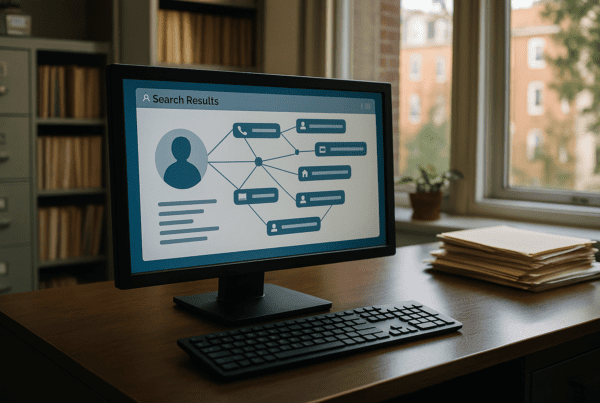

In the world of people search and public records, the ability to link identities accurately across disparate data sources is increasingly critical. Automated identity linkage is emerging as a technology that shapes this landscape, helping to merge fragmented information into coherent profiles without relying solely on manual checks or isolated databases.
From Patchwork Records to Seamless Connections
People search has historically been a bit like putting together a jigsaw puzzle where many pieces come from different boxes and do not always fit neatly. Records often exist separately-for example, property deeds, phone numbers, or voter registrations-each collected and stored by different entities. Automated identity linkage attempts to resolve this by applying algorithms that recognize patterns and signals common to the same individual, such as name variations, address history, or linked phone numbers.
These systems use combinations of exact matching and probabilistic reasoning to guess when two or more records likely belong to one person. While the concept has existed for some time, recent advances in machine learning and data access have made these connections more automated and scalable. This shift contrasts sharply with older approaches that were labor-intensive and prone to missed links or false matches.
Technology Meets Real-World Data Complexity
Even with automation, identity linkage involves nuances because human identity data rarely fits into neat, consistent formats. Misspellings, cultural naming differences, frequent moves, and partial records all muddy the waters. Algorithms have to weigh these factors carefully without simply assuming exact matches are always correct.
For example, a common challenge arises with shared or similar names in a geographical area. Automated systems complement name and address matching by checking associated data points like relatives or employers, which can also be drawn from public records or online directories. This multi-layered approach not only increases the chances of accurate linkage but also generates richer, context-aware profiles.
On the other hand, these methods depend heavily on the quality and recency of the available data. Outdated or incomplete records can lead to mistaken links, underscoring the ongoing challenge of balancing breadth of coverage with accuracy. The technology has improved but operates within the limits and imperfections inherent in public data.
Modern Challenges in Identity Linkage Accuracy
As the volume of data grows, automated identity linkage must grapple with the increasing complexity of verifying identities in a noisy environment. Common names shared by many individuals, typographical errors in records, and deliberate attempts to obscure identity contribute to difficulties in establishing reliable matches. Sometimes, two unrelated individuals appear nearly identical through their digital footprints, requiring deeper analysis.
Besides tracing address or phone number patterns, systems may incorporate metadata such as timing of record creation or usage habits drawn from transactional records. These subtleties can help tease apart people with overlapping details but caution is required not to over-interpret weak signals. The risk of false positives remains a reminder that no automated system is perfect.
Moreover, identity linkage tools often have to handle transient identities-people who have changed names, merged households, or adopted new contact information. These real-life shifts create gaps and ambiguities that technology tries to fill, sometimes producing provisional connections that require human review in sensitive cases.
The Impact on Users and Privacy Concerns
For users of people search services, automated identity linkage often means faster results and more comprehensive profiles. It can assist in reconnecting with old acquaintances, verifying background information, or conducting research with less guesswork. At the same time, it raises questions about privacy and data sensitivity.
As linkage technology creates more extensive profiles combining diverse records, individuals may find more personal information readily accessible than they expected. While public records are, by definition, publicly available, aggregating them in one place enhances their visibility.
This dynamic has caught the attention of privacy advocates and regulatory bodies. Companies developing and deploying automated linkage tools must navigate compliance with laws like the Fair Credit Reporting Act and related state regulations that govern the accuracy and permissible uses of personal data.
Transparency about data sourcing and linkage criteria becomes essential to maintain trust. Some services provide mechanisms for individuals to dispute or remove inaccurate information, reflecting an awareness of potential errors in automated matching.
Looking Ahead: Where Does Identity Linkage Go From Here?
The evolution of automated identity linkage will likely continue alongside improvements in artificial intelligence and data integration. Additional data sources, such as social media signals or transactional histories, could be integrated cautiously to refine matches. This may enhance the resolution of common challenges like differentiating people with identical names or linking across geographic moves.
However, the merging of more data also increases pressure to handle ethical considerations responsibly. Questions about consent, data minimization, and potential misuse call for ongoing vigilance. The interplay between technological possibility and regulatory guardrails is an area to watch carefully.
For those engaged in people search, whether professionals or private individuals, recognizing the strengths and limits of automated identity linkage is key. It offers powerful tools for connecting data points, but these tools operate within a complex, evolving data ecosystem where uncertainty and care both reside.
As this technology unfolds, it complements traditional investigation methods rather than completely replacing them. Observing these trends shows how public data is not static but shifts meaning and accessibility through the ways we link and interpret information.
For more detailed background on identity linkage and public records, resources such as the National Institute of Standards and Technology on Identity Management provide technical insights. The Federal Trade Commission discusses public data and privacy nuances, helping clarify user rights and company responsibilities. Additionally, sites like Privacy Rights Clearinghouse explore identity theft risks linked to public data aggregation, lending perspective on safety considerations.
Sources and Helpful Links
- National Institute of Standards and Technology on Identity Management – Technical insights into identity verification and management.
- Federal Trade Commission on Public Data and Privacy – Explains user protections and company data practices.
- Privacy Rights Clearinghouse – Information on data breaches and identity theft risks.