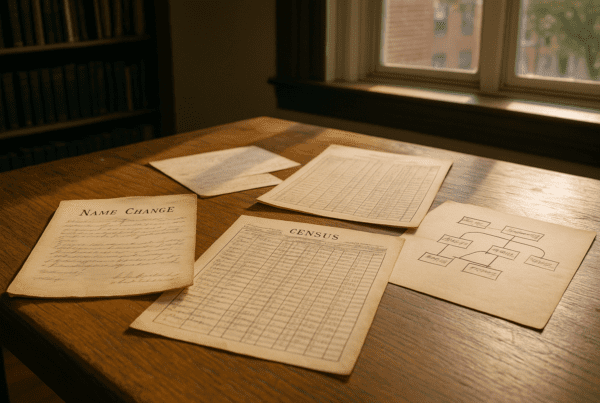

Genealogy often begins with names, dates, and familial ties recorded on official forms. Birth certificates, marriage licenses, or death records sketch who our ancestors were in the most fundamental ways. Yet, when attention turns to family migration, something less obvious comes into view. This dimension is about movement-through towns, across counties, shifting states-which traditional genealogical charts rarely capture in full detail. Public records invite us into this evolving story, revealing how families navigated changing economic conditions, social upheavals, or personal circumstances, responding to forces larger than any one person.
Tracing Life Through Places and Time
Genealogical research tends to prioritize bloodlines and direct descent. It creates a framework linking one generation to the next, often focusing on parents and children. That foundational work fulfills a key need but only reveals half the story. Where ancestors lived, how long they stayed, or what spurred them to relocate remains mostly hidden without consulting broader public records. Sources such as census enumerations, property transactions, and voter registrations layer on geographic context. They show families planted or uprooted, hinting at life beyond simple lineage.
Census records stand out as particularly rich sources. The U.S. Census Bureau compiles snapshots every ten years that list household members, occupations, and residences. By comparing these data points across decades, you can watch families gradually shift from rural farms into towns or venture across state lines seeking new opportunities. This steady map of whereabouts reflects larger migration trends, such as expansion westward or urbanization during industrialization.
Addresses Marking Journeys of Migration
Property and address records tell a less obvious but equally vital story. Land deeds, mortgage filings, and tax rolls held in county offices document when and where families acquired or sold property. Such documents provide hard evidence of residence, not just ties to parentage. These records can capture migrations over short distances or long relocations that might otherwise be forgotten or unrecorded elsewhere.
When combined with city directories, old phone books, and local voter lists, address records sketch detailed movements within communities or beyond. For example, the Great Migration of African American families in the early to mid-20th century, moving from Southern states to Northern cities, becomes clearer through these clues. Property transfers and addresses shifting state by state show that migration was often gradual and connected to changing social landscapes and job markets rather than spontaneous or isolated travel.
Work and Education as Migration Milestones
Employment and schooling add further texture to migration history. Families often moved for new jobs, military service, or educational access. Public records documenting such events, including military discharge papers or school enrollment lists, can pinpoint when a family began life in a new place.
Census data can hint at occupational changes but typically stops short of telling why a move happened. School yearbooks or enrollment records preserved by local districts reveal children’s presence in new towns, sometimes marking a family’s first settlement in an area. Military records captured by the National Archives Military Records show how service could influence moving from one region to another, especially when veterans settled where they were stationed.
These records show migration is often tied to economic shifts. Families moved to take advantage of growing industries or left areas facing decline. Understanding this context helps trace the socio-economic factors shaping family routes over generations.
Legal Documents Cast Light on Migration Motivations
Beyond basic residency, court and legal documents frequently offer unexpected insights about why families moved. Cases involving property disagreements, divorces, guardianships, or naturalizations contain details about addresses and family members that may not appear elsewhere. They can shed light on the pressures driving migration such as economic struggles, custody battles, or the need to establish citizenship in a new country.
Naturalization records found through the National Archives Immigration Research are particularly compelling. They reveal immigrant arrival points, subsequent movements, and eventual settlements. Coupled with local court files or directories, these documents trace how families transitioned into new communities, often navigating legal and cultural integration in the process.
Piecing Together Migration Histories for Fuller Understanding
Pulling together family migration stories from public records requires patience and an eye for connection. Those pieces tend to be scattered across many types of records and repositories. Online resources like FamilySearch offer extensive collections that simplify certain searches but often the richest details are found in local archives or historical societies.
This mosaic approach enriches genealogy by layering geographic and social context onto straightforward birth and marriage data. Tracking ancestors as they moved from place to place reveals patterns shaped by work, schools, laws, or economic conditions. Rather than static family trees, migration histories present family life as dynamic and location-sensitive.
Ultimately, migration stories speak to resilience and adaptation. They show how real people encountered and responded to historical events such as economic booms, wars, or cultural shifts. Public records become vibrant windows into these journeys, documenting how families laid down roots, moved on, and redefined their lives across generations and landscapes.
For anyone exploring family roots, migration adds a vivid, human scale. It transforms a simple pedigree chart into a living map, tracing where and how families moved through time, carrying stories of hope, struggle, and change embedded in every address and record.
Sources and Helpful Links
- U.S. Census Bureau – Official site offering access to census data essential for tracking residential history and demographics.
- National Archives Immigration Research – Resource for accessing immigrant records and naturalization documents.
- FamilySearch – A comprehensive genealogy site with free access to a wide range of public records and indexes.
- Local Historical and Government Archives – Example of local archives that contain property, court, and vital records useful for migration research.
- National Archives Military Records – Military documentation that aids in tracing migration tied to service and resettlement.